Every month, thousands of businesses launch websites, products, and campaigns with the help of digital marketing agencies. And every month, a shocking percentage of those launches fail not because of bad marketing, but because the foundation was broken before the first ad ever ran.
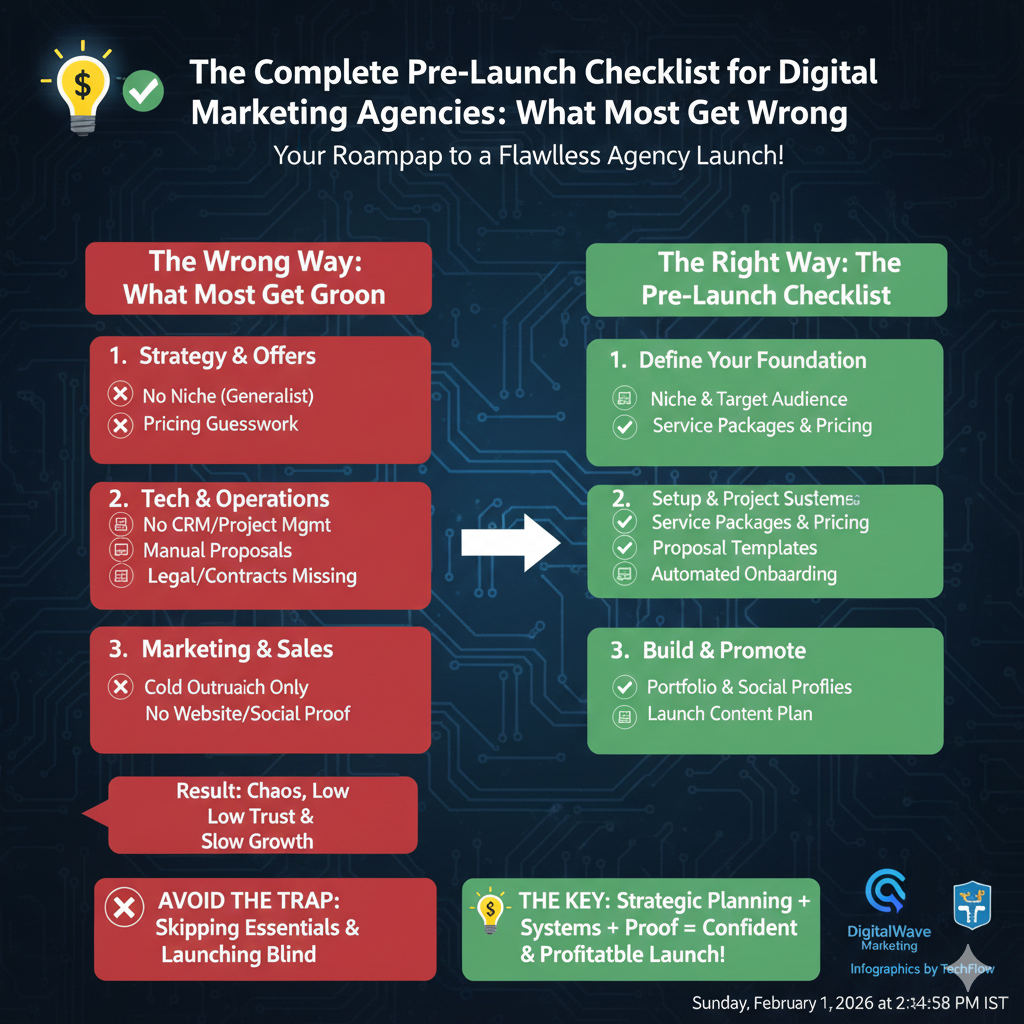
I’ve watched this pattern repeat across hundreds of client projects. A business hires a talented agency, approves a brilliant campaign strategy, and launches with enthusiasm. Three months later, they’re hemorrhaging money with nothing to show for it. The creative was excellent. The targeting was precise. The budget was appropriate.
But nobody checked if the basics were in place first.
This isn’t about campaign tactics or growth hacks. This is about the unglamorous infrastructure that separates marketing investments that compound over time from marketing expenses that evaporate the moment you stop spending.
If you’re a business about to work with a digital marketing agency or an agency about to take on a new client, this checklist might be the most valuable 15 minutes you spend this month.
The Foundation Most Agencies Skip
Digital marketing agencies are paid to generate results: traffic, leads, conversions, revenue. There’s immense pressure to show value quickly, especially in the first 90 days when clients are evaluating whether to continue the relationship. This creates a dangerous incentive to skip foundational work and jump straight into campaigns.
The logic seems sound: “We’ll fix the technical stuff later, right now we need to prove we can drive traffic.” Except that’s like pouring water into a bucket with holes and planning to patch the holes once you’ve proven you can turn on the faucet. The water you’re pouring (your marketing budget) is disappearing as fast as you add it.
The businesses that succeed with digital marketing don’t just hire good agencies. They ensure their foundation is solid before the agency work begins. When that foundation exists, campaigns work better, conversion rates are higher, and every dollar spent compounds instead of evaporates.
Here’s what that foundation actually looks like.
Brand Identity That Won’t Embarrass You in Six Months
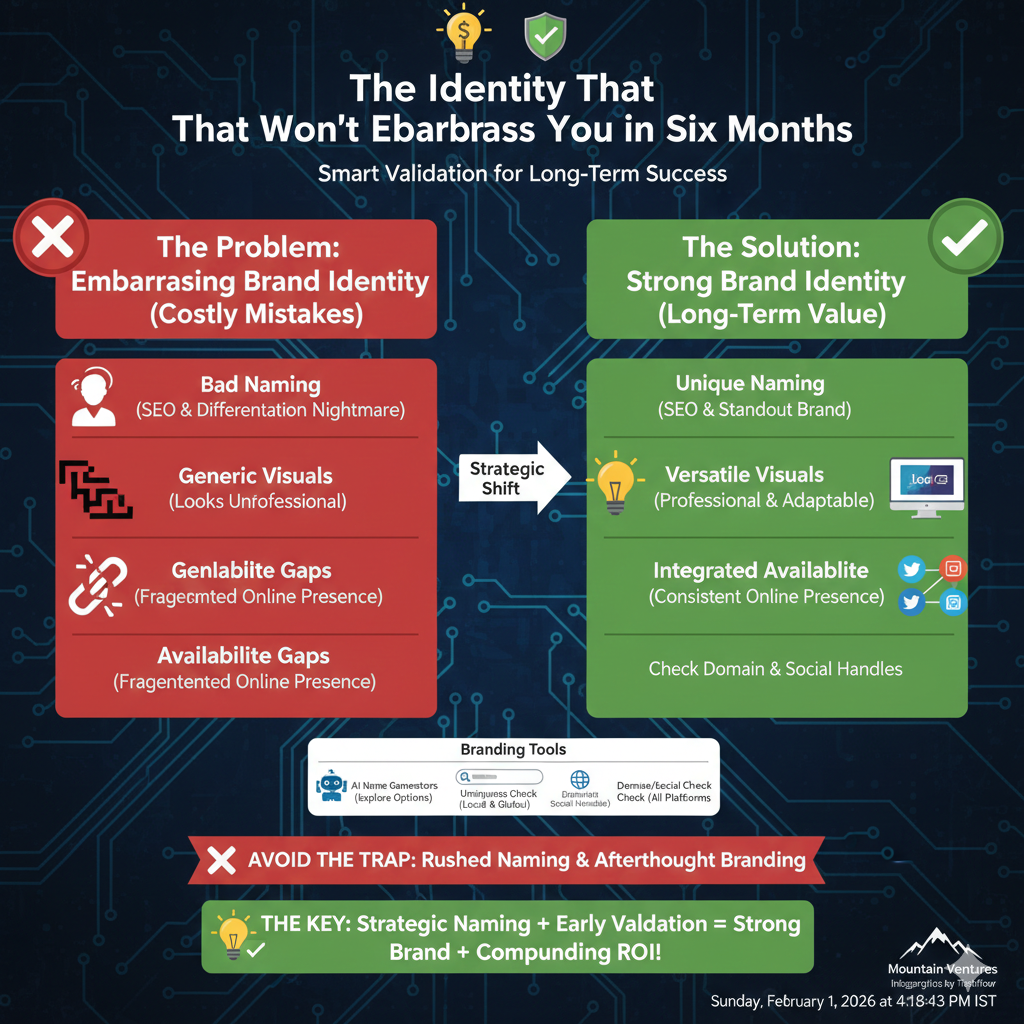
This sounds obvious, but you’d be shocked how many businesses launch major marketing campaigns with branding they’re already half-embarrassed about.
Maybe the founder spent 20 minutes brainstorming a name and picked one that’s difficult to pronounce, impossible to spell, or accidentally similar to a competitor in the same space. Maybe they used the first logo template they found online without thinking about how it looks at different sizes or on different backgrounds. Maybe their brand colors were chosen based on personal preference rather than what actually works in digital contexts.
None of this seems critical when you’re pre-revenue and rushing to launch. But once you’re spending ₹50,000 a month on ads pointing to that brand, changing it becomes exponentially more expensive and disruptive. You’ve built equity in the wrong name. Your audience knows you as the brand you now want to change. The URL you bought is now indexed in Google.
Smart businesses validate their brand identity before the agency spends a rupee on marketing. This doesn’t mean hiring a ₹5 lakh brand consultancy, it means investing a few hours in thoughtful decision-making.
Test if people can spell your brand name after hearing it once. If you tell someone your business name in conversation and they can’t find you when they search later, your word-of-mouth marketing is broken before it starts. This is especially critical for businesses that will do offline marketing, podcasts, or any channel where people can’t click a link.
Check how many businesses use similar names. There’s a difference between a name that’s in a crowded space and a name that’s truly unique. When you’re launching a business called “CloudSync Solutions” and there are 147 companies with “cloud” and “sync” in their names, you’re fighting an uphill SEO battle and a differentiation nightmare. Using similar business name checkers early saves years of competitive headaches.
Ensure your visual identity works across digital channels. That logo that looks great on your desktop might be illegible as a 16×16 favicon or when compressed for Facebook ads. Your brand colors might look amazing on your monitor but terrible on the majority of mobile screens where your customers will actually see them. Test these things before locking in.
Verify domain and social handle availability together. Choosing a brand name that has an available .com is the bare minimum. You also need to check if the Instagram, LinkedIn, Twitter, and YouTube handles are available. If your brand is “Apex Marketing” but @apexmarketing is taken on every social platform, you’ll end up with fragmented presence like @apexmarketingindia or @apexmktg, which dilutes your brand.
The businesses that nail this use AI-powered name generators to explore hundreds of options quickly, then validate the winners against business name uniqueness and domain availability. This front-loaded effort pays dividends for years because every piece of marketing points to a brand that’s strong, available, and differentiated.
Technical SEO That Won’t Sabotage Your Campaigns
You can run the perfect Google Ads campaign, but if your technical SEO is broken, you’re paying more for every click and converting fewer visitors into customers. Most businesses discover these issues months into their agency relationship, after they’ve already burned through tens of lakhs in budget fighting problems that should have been fixed before launch.
Google can’t index what it can’t find. Your sitemap is the roadmap that tells search engines what pages exist on your site and how to prioritize them. Launching without a proper sitemap is like printing brochures without listing your address. Sure, people can stumble into your store, but you’re making it exponentially harder for anyone to find you deliberately. Generating a comprehensive sitemap in multiple formats should be step one of any website launch, not something you add later “when you have time.”
Page speed directly impacts your ad costs. Google’s Quality Score for ads factors in landing page experience. A slow-loading page means you pay more per click for the same ad position. More critically, slow pages kill conversion rates. For every second your page takes to load, you lose a percentage of visitors who bounce before seeing your offer. Businesses obsess over ad copy and bidding strategies while ignoring that their 8-second page load is destroying their ROI.
Mobile responsiveness isn’t optional anymore. Over 70% of Indian internet users are mobile-first or mobile-only. If your site looks broken on mobile or requires horizontal scrolling, you’re alienating the majority of your potential customers. Agencies can drive massive mobile traffic, but if that traffic bounces because your site is unusable on phones, the campaign looks like a failure even though the problem was entirely on your end.
SSL certificates affect trust and rankings. The little padlock in the browser bar seems trivial, but its absence screams “don’t trust this site” to visitors. Google also ranks HTTPS sites higher than HTTP equivalents. Launching major campaigns without proper SSL is leaving money on the table in both paid and organic channels.
The businesses that succeed ensure these technical foundations are solid before spending on campaigns. They generate comprehensive sitemaps for search engines. They run page speed tests and fix obvious bottlenecks. They verify their sites work flawlessly on mobile devices. They ensure security fundamentals are in place.
These aren’t expensive fixes, they’re just systematically neglected because they’re not exciting compared to launching campaigns. But the ROI on fixing them is often better than the ROI on the campaigns themselves.
If you’re building your website on Elementor, you already know how powerful it is—but paying for Elementor Pro isn’t the only way to unlock “pro-level” results. The truth is, most people don’t use even 40% of what Pro offers. With the free version and a few smart workarounds, you can still create stunning, high-converting pages without spending a rupee.
Pair Elementor’s Pro free builder with lightweight add-ons, free templates, and plugins like header/footer builders, form tools, and popup creators, and you can replicate many Pro features—forms, sliders, testimonials, and even dynamic sections. For startups, freelancers, or small businesses testing ideas, this approach keeps costs low while still giving you professional design control.
Instead of upgrading immediately, focus first on clean layouts, fast loading speed, and strong copy—because great marketing always beats fancy features. Once your site actually starts generating revenue, then Pro becomes an upgrade, not an expense.
Lead Capture Infrastructure That Doesn’t Waste Opportunities
Your agency can drive 1,000 visitors to your landing page, but if your lead capture infrastructure is broken, you might convert 10 when you should have converted 100. This is the most painful category of self-inflicted wounds because you’re paying for traffic that your broken systems can’t monetize.
Form fields that ask for too much too soon. Every additional field you add to a form decreases completion rates. Businesses that ask for email, phone, company name, company size, budget, timeline, and pain points on the first interaction are optimizing for their internal convenience rather than conversion rate. The best lead capture follows a progressive model: ask for the minimum viable information to start the conversation, then gather more details as the relationship develops.
Confirmation emails that never arrive. You built a great form. Someone filled it out. They’re waiting for the download link or meeting confirmation that never shows up because your email deliverability is broken, your automation is misconfigured, or their email provider flagged your message as spam. From their perspective, your business is incompetent. From your perspective, you just paid ₹500 for a lead you’ll never be able to follow up with.
No immediate value delivery. Modern consumers are trained to expect instant gratification. If someone signs up for your lead magnet and has to wait for a sales rep to manually send it during business hours, you’ve introduced friction that causes abandonment. The best systems deliver value within seconds of signup, building trust and momentum when interest is highest.
CRM integration that breaks under load. Your form submits to your CRM successfully when you test it with five submissions. Then your agency launches a campaign that drives 500 submissions in a day, and suddenly leads are getting lost because your integration hits rate limits, your CRM plan doesn’t support that volume, or the webhook times out under load. You just paid for leads you’ll never even know about.
No filtering for junk leads. This deserves special attention because it’s invisible in most analytics. Your campaign drives 200 form submissions. Your agency celebrates the cost-per-lead metrics. Then your sales team calls and discovers that 60 of those “leads” used disposable email addresses that bounce, another 30 are clearly competitors doing research, and 20 more are students with zero buying intent.
The real cost-per-qualified-lead is 3x what the dashboard showed, but nobody measured that until three months in when the CFO asks why marketing isn’t generating revenue.
Smart businesses implement real-time email verification on their forms before launching campaigns. They filter out disposable email addresses at the point of capture, before these junk entries pollute the CRM and waste sales time. They ensure their forms are optimized for conversion while still capturing enough information to qualify interest. They test their systems under realistic load before the campaign starts.
Conversion Tracking That Actually Measures What Matters
Here’s a scenario that plays out constantly: A business hires an agency, launches campaigns, and starts getting reports showing strong performance. Click-through rates look good. Cost per click is reasonable. The number of “conversions” is growing month over month.
Six months later, the CEO asks the CFO, “What’s our ROI on the digital marketing spend?” And the CFO says, “I have no idea. I see the invoices, but I can’t connect them to revenue.”
This happens because conversion tracking was set up to measure the wrong things or wasn’t set up properly at all.
Tracking form submissions instead of qualified leads. Your analytics show 500 conversions. But how many of those were actually qualified prospects versus freebie seekers, competitors, or bots? If you’re optimizing campaigns based on raw conversion volume, you’re potentially doubling down on channels that generate junk while under-investing in channels that generate real business.
No connection between marketing spend and closed revenue. The gold standard is closed-loop attribution: being able to trace a specific sale back to the specific campaign, ad, and keyword that initiated the relationship. Most businesses can’t do this because their CRM and analytics aren’t properly integrated. They can tell you how much they spent on marketing and how much revenue they generated, but they can’t connect specific spend to specific outcomes.
Attribution models that give credit to the wrong touchpoints. Last-click attribution gives all credit to the final touchpoint before conversion, which systematically under-values top-of-funnel brand awareness efforts. First-click attribution does the opposite. Neither model reflects reality, which is that most B2B purchases involve multiple touchpoints over weeks or months. Businesses making decisions based on flawed attribution are optimizing for the wrong thing.
Offline conversions that never get tracked. You run digital campaigns that drive phone calls, walk-ins, or conversations at trade shows. These convert into deals, but because they don’t happen through a trackable online form, they’re invisible in your marketing analytics. Your digital campaigns look less effective than they are, leading to under-investment in channels that are actually working.
The businesses that get this right implement proper tracking before the campaigns start. They ensure their analytics can track not just clicks and form fills, but qualified lead designation and eventually closed revenue. They use UTM parameters consistently so they can track which specific campaigns and content drive results. They build processes to capture offline conversions and feed them back into the analytics.
This isn’t sexy work. It’s technical and detailed and easy to procrastinate. But it’s the difference between making data-driven optimization decisions and flying blind while hoping for the best.
The Agency-Client Handshake That Sets Everything Up for Success
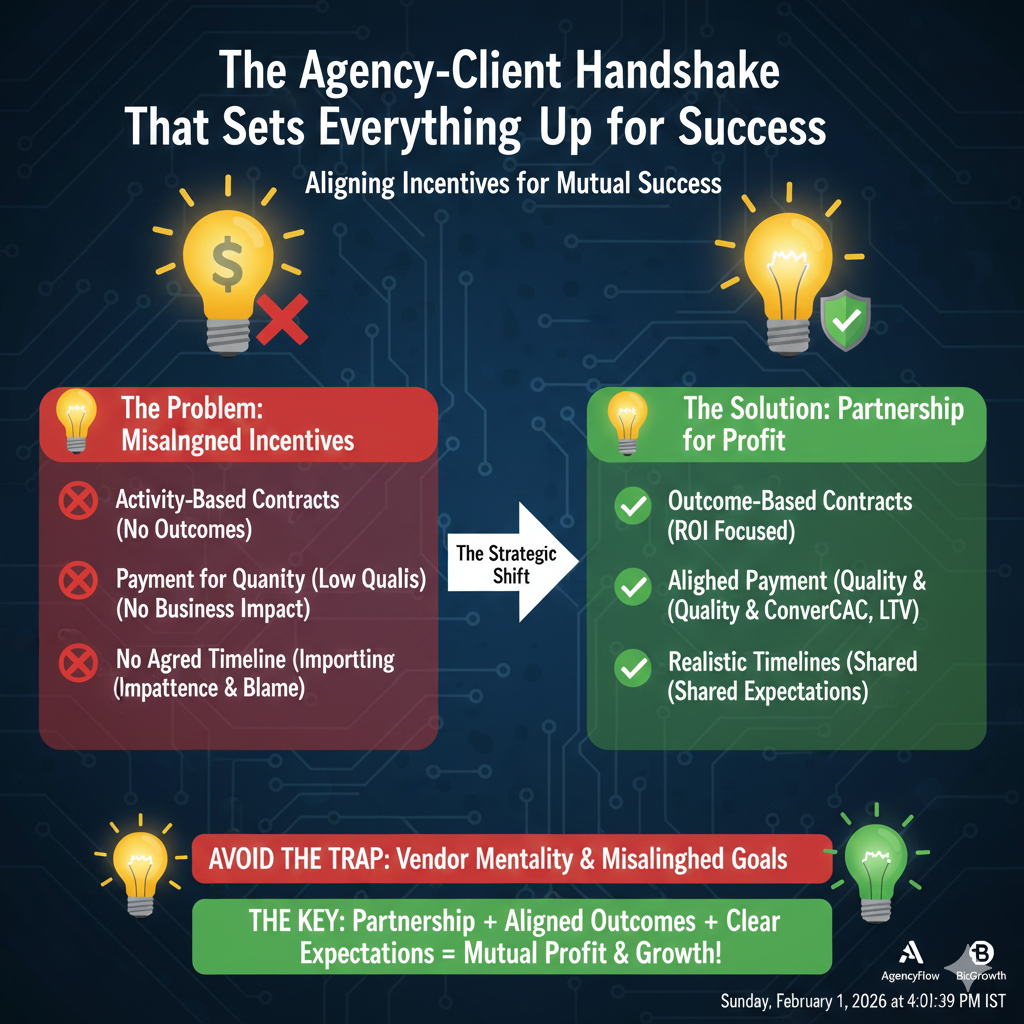
The final foundation piece is the relationship structure between business and agency. Most agency-client relationships are set up to optimize for the wrong outcomes, creating misaligned incentives that guarantee mediocre results.
Contracts focused on activity instead of outcomes. “We’ll publish 12 blog posts per month, run 3 ad campaigns, and send 8 email newsletters.” This tells you what the agency will do, but it doesn’t tell you what results they expect to drive or what happens if those results don’t materialize. Activity-based contracts create an incentive to do the work without necessarily driving the outcome.
Payment structures that reward quantity over quality. If the agency gets paid more for driving more leads, regardless of whether those leads convert, they’re incentivized to optimize for volume. This is fine if you have strong internal lead qualification and don’t mind wasting sales time on junk. It’s terrible if you’re resource-constrained and need every lead to count.
Reporting that emphasizes vanity metrics. Beautiful monthly reports showing traffic growth, social media engagement, and form submission volume feel good but might not correlate with business outcomes. The best agency relationships include regular reviews of metrics that actually matter: cost per qualified lead, conversion rate to opportunity, customer acquisition cost, and lifetime value of customers from different channels.
No agreed-upon timeline for seeing results. Digital marketing is not instant gratification. SEO takes months. Content marketing builds gradually. Paid advertising can drive immediate traffic but might need weeks of optimization to become profitable. Without clear expectations about timeframes, businesses get impatient and agencies get defensive.
The businesses that succeed with agency relationships establish clear expectations up front. They define what success looks like in terms of business outcomes, not just marketing activity. They align payment structures with outcomes when possible, or at minimum, they tie agency bonuses to metrics that correlate with revenue. They agree on realistic timelines for different channels and strategies.
Most importantly, they view the agency as a partner rather than a vendor. Partners collaborate on solving problems. Vendors deliver services and collect payment. The difference in outcomes is dramatic.
What to Do Tomorrow
If you’re a business about to launch marketing campaigns, your first conversation should be about foundations, not tactics. Before discussing which ad platforms to use or what content to create, ensure you have:
A brand identity you can commit to for years, not months. Test your business name for uniqueness and memorability. Verify your logo works across all the contexts where it will appear. Make sure your domain and social handles are secured.
Technical infrastructure that won’t sabotage campaigns. Generate proper sitemaps for search engines. Fix obvious page speed issues. Verify mobile responsiveness. Get your SSL certificate sorted.
Lead capture systems that maximize the value of traffic. Optimize forms for conversion while filtering junk. Ensure automated emails actually send and deliver value immediately. Implement proper CRM integration that won’t break under load.
Conversion tracking that measures what matters. Set up analytics to track not just clicks but qualified leads and revenue. Build attribution models that reflect your actual customer journey. Create processes to capture offline conversions.
An agency relationship structure optimized for outcomes. Define success in business terms, not just marketing metrics. Align incentives where possible. Establish realistic timelines and reporting on what actually matters.
None of this is exciting. It won’t impress stakeholders in a presentation. It’s not the kind of work that wins creativity awards or generates case studies.
But it’s the difference between marketing that compounds over time and marketing that’s a recurring expense with inconsistent returns. It’s the difference between agencies that genuinely drive business growth and agencies that create activity without impact.
The businesses that win with digital marketing don’t skip these foundations. They build them first, meticulously and systematically. Then, when they’re ready to launch campaigns, those campaigns work better, cost less, and drive outcomes that actually matter.
Your agency can’t build these foundations for you, at least not all of them. But they can help, and they should insist on them being in place before serious budget is deployed.
The question to ask your agency tomorrow isn’t “what campaigns should we run?” It’s “what foundations do we need in place before those campaigns will actually work?”
Their answer will tell you everything you need to know about whether they’re optimizing for your success or just their own.
Conclusion
At the end of the day, great marketing isn’t about who has the flashiest ads or the smartest growth hacks—it’s about who built their house on solid ground before inviting traffic in. Campaigns don’t fix weak foundations; they expose them. If your brand is forgettable, your site is slow, your forms leak leads, or your tracking can’t prove revenue, every rupee you spend just magnifies those cracks. But when the basics are tight—clear identity, clean tech, reliable systems, and measurable outcomes—marketing suddenly feels easier, cheaper, and more predictable. Results compound because nothing is being wasted. So before you ask an agency how to scale, ask how to stabilize. Fix the plumbing before turning on the tap. Because the businesses that win aren’t louder—they’re prepared. And once the foundation is right, almost any decent campaign works.