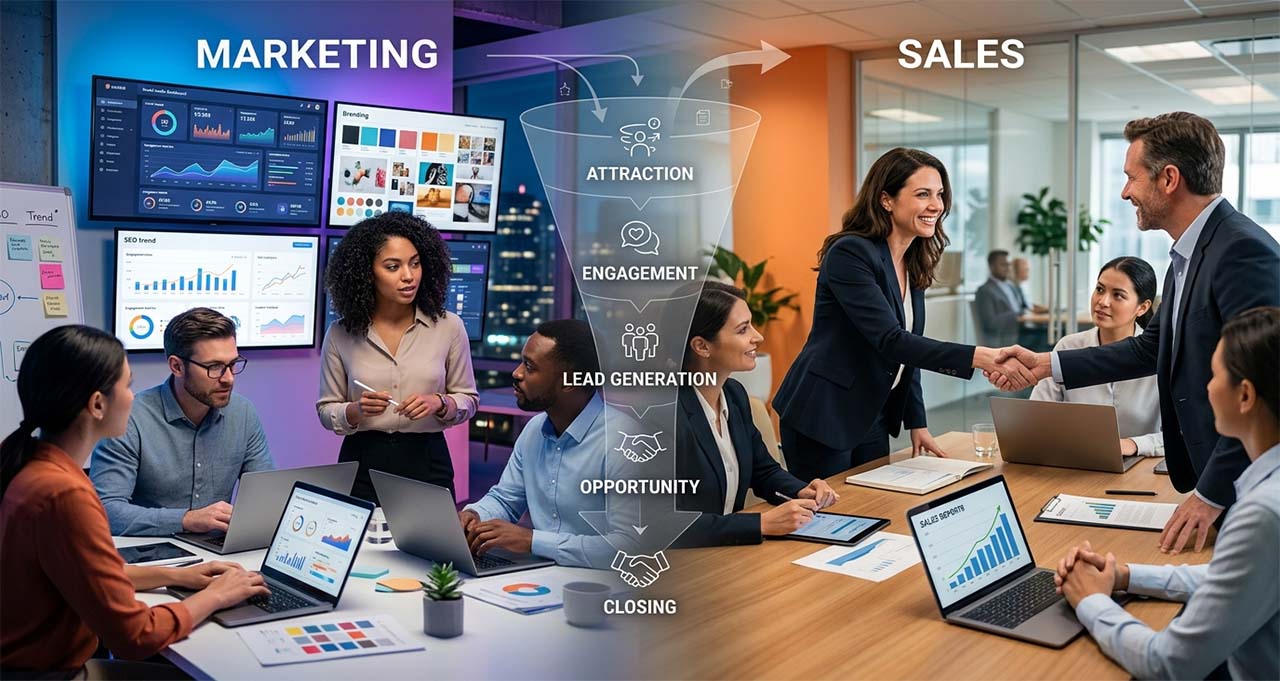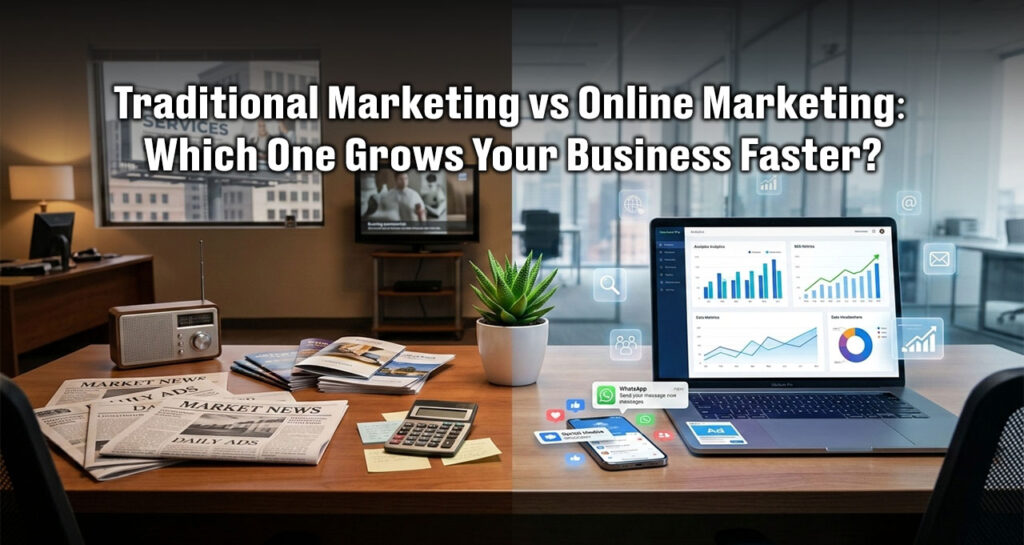
Every business owner eventually faces the same challenge: Traditional Marketing vs Online Marketing: Which One Grows Your Business Faster?
You invest money in promotions, but growth feels slow. Leads are inconsistent. Sometimes the budget gets exhausted without clear results. This creates confusion and frustration.
Should you continue with traditional methods like newspaper ads and billboards? Or should you shift your focus to digital platforms like Google and social media?
Understanding the strengths and limitations of both approaches will help you make smarter decisions. Let’s explore both clearly and practically.
What is Traditional Marketing?
Traditional marketing refers to offline promotional methods used before the rise of the internet. These methods focus on reaching audiences through physical or broadcast channels.
For many years, this was the primary way businesses promoted their products and services.
Common Examples
- Television advertisements
- Radio advertisements
- Newspaper ads
- Magazine ads
- Billboards
- Flyers and brochures
- Trade shows and exhibitions
These methods generally aim at a broad audience rather than a specific target group.
Benefits of Traditional Marketing
- Strong local brand visibility
- Effective for mass awareness
- Trusted by older demographics
- Suitable for events and physical promotions
- Tangible materials create credibility
Traditional marketing can help build brand recognition, especially in local markets.
Limitations of Traditional Marketing
- High production and advertising costs
- Difficult to measure exact results
- Limited audience targeting
- Slow feedback and optimization
- Fixed campaigns once published
For example, if a newspaper ad does not perform well, changes can only be made in the next publication cycle. This slows down improvement and growth.
What is Online Marketing?
Online marketing, also called digital marketing, promotes businesses through internet-based platforms. It allows businesses to connect with customers through search engines, websites, social media, and email.
Unlike traditional marketing, digital marketing offers detailed tracking and audience targeting.
Main Types of Online Marketing
Search Engine Optimization (SEO)
Improves website visibility on search engines like Google.
Social Media Marketing
Promotes brands on platforms such as Facebook, Instagram, LinkedIn, and others.
Google Ads (Pay-Per-Click Advertising)
Paid advertisements that appear in search results and websites.
Email Marketing
Direct communication with customers through email campaigns.
Content Marketing
Creating blogs, videos, and valuable information to attract customers.
Influencer Marketing
Collaborating with online creators to promote products or services.
Why Businesses Prefer Online Marketing
- Precise audience targeting
- Lower entry cost
- Measurable performance
- Quick campaign adjustments
- Scalable growth opportunities
- Global reach
Digital marketing gives businesses full control. You can track clicks, conversions, cost per lead, and return on investment in real time.
Comparison Table
Factor | Traditional Marketing | Online Marketing |
Cost | High setup and media costs | Flexible and adjustable budgets |
Speed | Slow launch and feedback | Fast launch and quick optimization |
Targeting | Broad audience | Highly specific audience targeting |
Measurable Results | Limited tracking | Detailed real-time analytics |
Lead Generation | Indirect | Direct and trackable |
Budget Control | Fixed | Easily adjustable |
Global Reach | Local or regional | Worldwide access |
This comparison highlights why many modern businesses prefer digital channels.
Which One Grows a Business Faster?
Speed of Results
Online marketing campaigns can be launched within hours. Leads can start coming in the same day.
Traditional marketing usually requires more preparation time and slower response cycles.
Cost Efficiency
Digital platforms allow businesses to start with small budgets and scale gradually.
Traditional campaigns often require larger upfront investments.
Lead Generation
Online marketing captures leads directly through forms, calls, or messages.
Traditional marketing depends on customers remembering and responding later.
Tracking and Data
Digital marketing provides detailed insights such as:
- Website visits
- Click-through rates
- Conversion rates
- Cost per acquisition
Traditional marketing does not offer this level of detailed tracking.
Scalability
Online campaigns can be scaled based on performance data. If something works, the budget can be increased strategically.
In most cases, online marketing grows a business faster due to its flexibility, measurable results, and targeting accuracy.
When Traditional Marketing Still Works
Traditional marketing remains useful in certain situations:
- Local businesses targeting nearby customers
- Large-scale awareness campaigns
- Audiences less active online
- Premium brand positioning
- Event promotions
When used strategically, traditional marketing can complement digital efforts.
Why Online Marketing Is More Effective for Modern Businesses
Lower Customer Acquisition Cost
Digital platforms often generate leads at a lower cost compared to television or print ads.
Real-Time Performance Monitoring
Businesses can track campaign performance instantly and make improvements immediately.
Retargeting Capabilities
Online ads can target users who previously visited your website but did not convert.
Automation
Email marketing and advertising platforms offer automation features that save time and improve consistency.
Performance-Based Advertising
Businesses can pay for measurable actions such as clicks or conversions.
Predictable Growth
With data-driven insights, businesses can forecast and scale growth more accurately.
The Smart Strategy: Combine Both
The most effective approach is often a balanced combination of traditional and online marketing.
For example:
- Use billboards for awareness
- Use Google Ads to capture search traffic
- Use social media to build engagement
- Use email marketing to nurture leads
This integrated approach maximizes visibility and conversions.
Common Marketing Mistakes to Avoid
- Not defining a target audience
- Ignoring performance tracking
- Poor budget allocation
- Skipping testing phases
- Running inconsistent campaigns
- Expecting immediate results
- Failing to analyze data
A clear strategy prevents wasted spending.
Simple Budget Planning Guide
For Small Businesses
Allocate your budget strategically:
- Focus majority on digital marketing
- Reserve funds for testing campaigns
- Invest in brand-building activities
Testing Phase
Start small. Test different:
- Ad creatives
- Target audiences
- Messaging strategies
Analyze results before increasing budgets.
Scaling Strategy
Increase spending only on high-performing campaigns. Avoid scaling unprofitable ads.
Reinvesting Profits
Reinvest a portion of marketing profits into expansion. This creates sustainable growth.
About Webnic Digital Solutions
Webnic Digital Solutions is a professional marketing partner focused on delivering measurable growth for businesses.
Services include:
- Search Engine Optimization (SEO)
- Social media marketing
- Paid advertising campaigns
- Lead generation systems
- Conversion-focused marketing strategies
The approach emphasizes strategy, data analysis, and consistent improvement to help businesses grow confidently.
FAQs
Is online marketing better than traditional marketing?
For most businesses today, online marketing offers better targeting, tracking, and cost control.
Which method provides faster return on investment?
Online marketing generally delivers faster measurable returns.
Is traditional marketing outdated?
No. It remains useful in specific industries and local markets.
What is best for startups?
Online marketing is usually more suitable due to lower initial costs and scalability.
How much should a small business invest in marketing?
Typically 5 to 10 percent of revenue, depending on growth goals.
How long does digital marketing take to show results?
Paid advertising can generate results quickly, while SEO may take several months.
Can traditional marketing generate leads?
Yes, but tracking and measurement are more limited.
Should businesses use both methods?
Yes. Combining both approaches often delivers stronger overall results.
Choosing between traditional marketing and online marketing depends on your business goals, audience, and budget. Traditional marketing builds awareness and credibility. Online marketing delivers measurable, targeted, and scalable growth.
For businesses seeking faster results, better tracking, and efficient spending, digital marketing offers a clear advantage.
The key to success lies in strategic planning, consistent testing, and ongoing performance monitoring. A balanced approach—combining brand-building efforts with data-driven digital strategies—can create sustainable growth.
Webnic Digital Solutions provides Digital Marketing services for your business growth. Our services are available in Bahrain, Kuwait, Oman, Qatar, Saudi Arabia, UAE, India, and beyond, helping businesses expand their reach, strengthen visibility, and achieve long-term success across regional and international markets.